
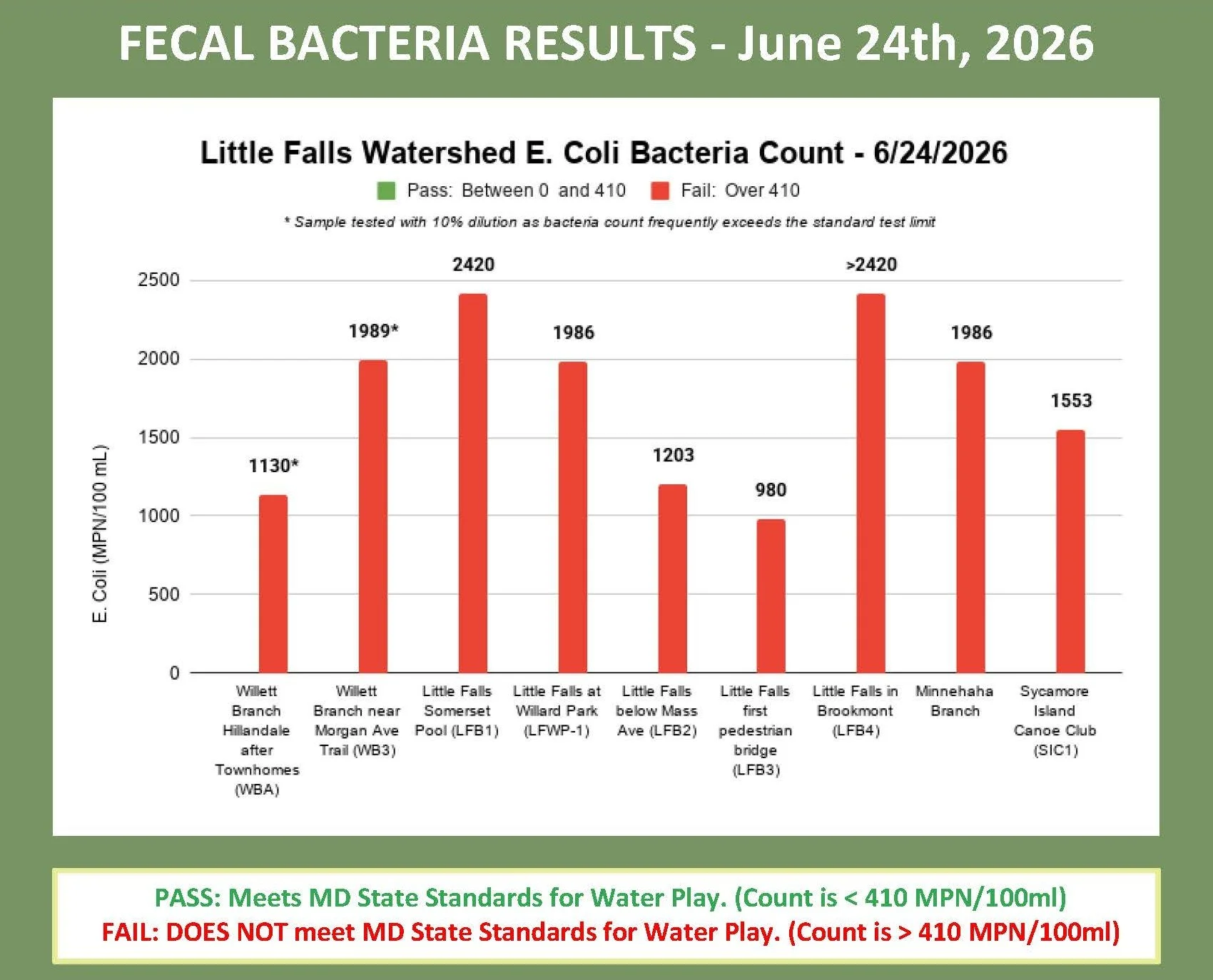
The creeks in our watershed have a serious fecal bacteria pollution problem. Last week, 9 out of 9 sites failed to meet the Maryland State criteria for safe water play (410 MPN per 100 ml). The week before, 5 out of 9 failed and the first week, 6 sites failed. Unfortunately, fecal bacteria pollution is not smelly and doesn’t look gross. It’s only by testing that we are able to learn whether the water is clean enough for kids to splash around. Fecal bacteria can cause serious digestive problems if ingested and secondary infections if allowed to enter the body through open sores. So, it’s important that the public is aware of this pollution problem.
Bacteria Monitoring Program
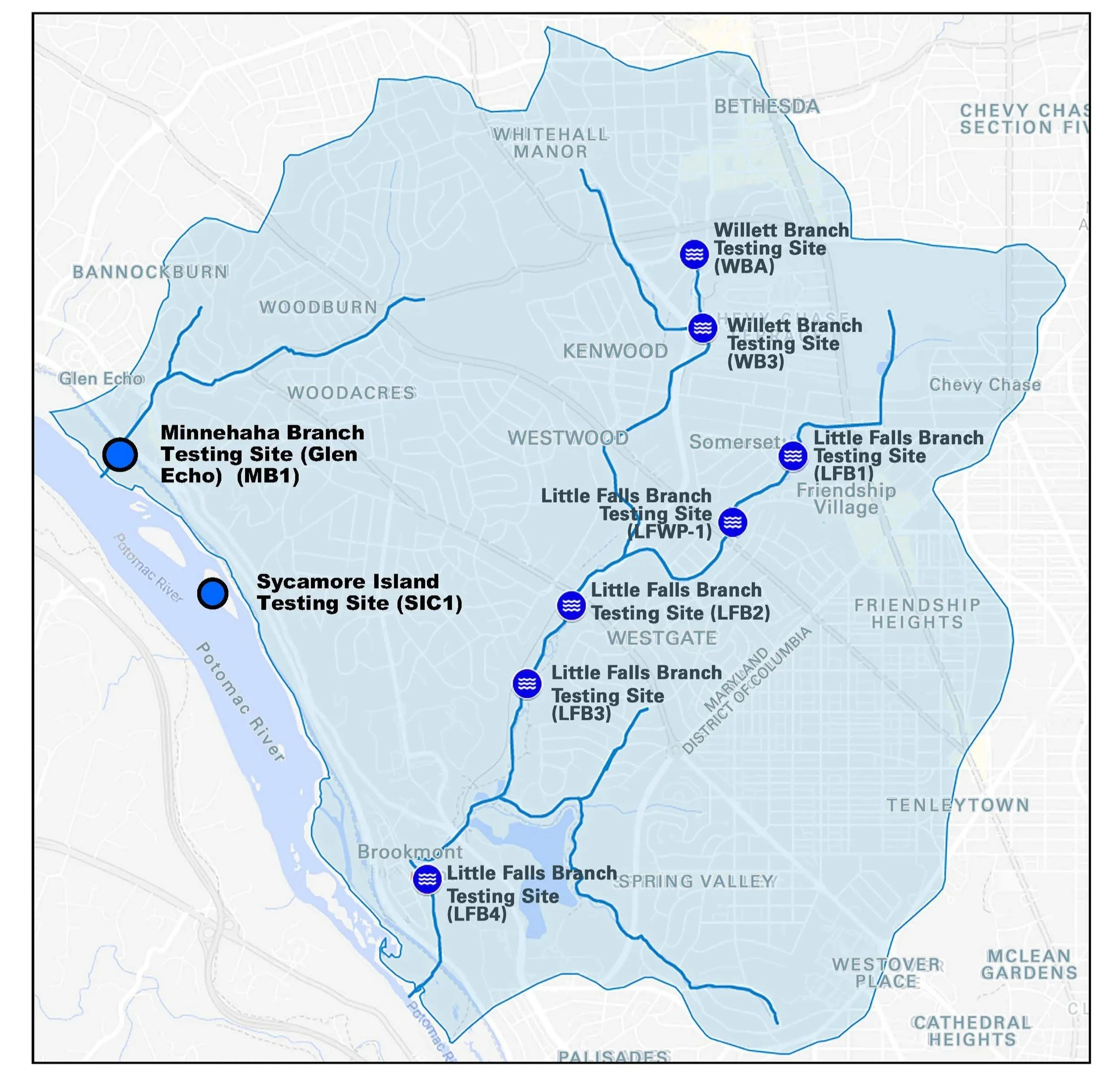
Fecal bacteria testing location in the Little Falls Watershed.
The LFWA weekly bacteria monitoring program started on June 17 and will run all summer until mid-September. Testing is done on Wednesday and the results are posted on our website and community listservs, Nextdoor.com and TheSwimGuide.org on Thursday after receiving the data from the lab.
We monitor the Little Falls Branch in 4 locations; the Willett Branch in 2 locations; the Minnehaha creek at Glen Echo; and new for this year, we are monitoring the Potomac River at Sycamore Island where there is a canoe club.
The program is run by trained citizen volunteers and we partner with American University who runs the samples in their lab.
Where does the Poop come from?
The question that the Little Falls Watershed Alliance gets most after we publish our results is "why is there so much fecal pollution?" That's a hard question. There are three main sources of fecal matter - domestic animal wastes (dog poop), wild animal poop, and human poop.
Dog poop is washed into the creek - either directly. or through the storm drain system. (All storm drains go directly to the creek.) So, picking up dog poop is a good way of keeping it out of the creek. Similarly, wild animal waste is also washed into the creeks. Not much we can do about that besides maintaining nice riparian buffers so that the run-off isn't so great. The vegetation can catch the poop, and also provide habitat for the bacteria and insects that eat poop. (Think dung beetles!)
Then there is the problem of human waste. In Montgomery County, where the creeks begin, there is a separate sewer and storm water waste system. That means that the source of the fecal matter should not be human unless the sewer system is leaking into the creek or waste water pipes are incorrectly plumbed and the wastewater is being sent to the storm drain system instead of the sewer treatment plants. Both are known problems and in the past decade, WSSC has addressed broken sewer pipes and incorrectly plumbed wastewater in several locations in the watershed.
For the really high numbers (over 4.000), we suspect that human waste contributes a lot as was the case in the Willett Branch several years ago. DNA testing at our sites there confirmed that the source was human and the Montgomery County Department of Environmental Protection confirmed this when it found that the toilets at the Hyatt Hotel in downtown Bethesda were misplumbed. They were discharging into the storm drain system instead of the sanitary waste (sewer) system. That problem has been fixed, but we are still seeing high numbers there. It's a mystery.
Please visit our bacteria monitoring page for more information about our program.