
Winter is here and there is one important thing that every homeowner can do to save their trees - remove any English Ivy that is growing up the trunks. Ivy can strangle trees, accelerate rot, attract mosquitoes and cause mature trees to fall down during storms. With the threat of snow, it's important that you pay attention to the last warning - the weight of snow added to the weight of the ivy can cause mature trees to fall down during storms.
Stormwater Management for Sumner Village
In January 2019, LFWA was awarded a $20,000 grant from the Montgomery County Department of Environment Protection to tackle the stormwater run-off problem at Sumner Village, a condominium community in Bethesda. The green areas by tennis court two had little or no vegetation and turned to a sea of mud when it rained. In addition, the creek adjacent to the area were experiencing considerable erosion due to rain water run-off. The fence has been moved several times in the past years because the bank has collapsed.
Westbard Plan Approved
What is ESD to the MEP and Why Do We Care About It?
UPDATE March 14, 2019. The Planning Board Approves Regency Center's application. Rejects our request for NO waiver.
Where Does Rain Water Go and Stormwater Management
When it rains, the water hits the ground, the pavement, the roof tops, driveways, parking lots, etc. Some of it soaks into the ground (infiltrates) and some of runs off the impervious surfaces into the storm drain system - down gutters, into storm drain pipes, finally ending up in our waterways through outfall pipes. Too much stormwater run-off in our rivers and creeks causes flooding, erosion, increased pollution, loss of habitat and degradation of the waterway banks.
LFWA to Track Impact of Road Salt on Creek
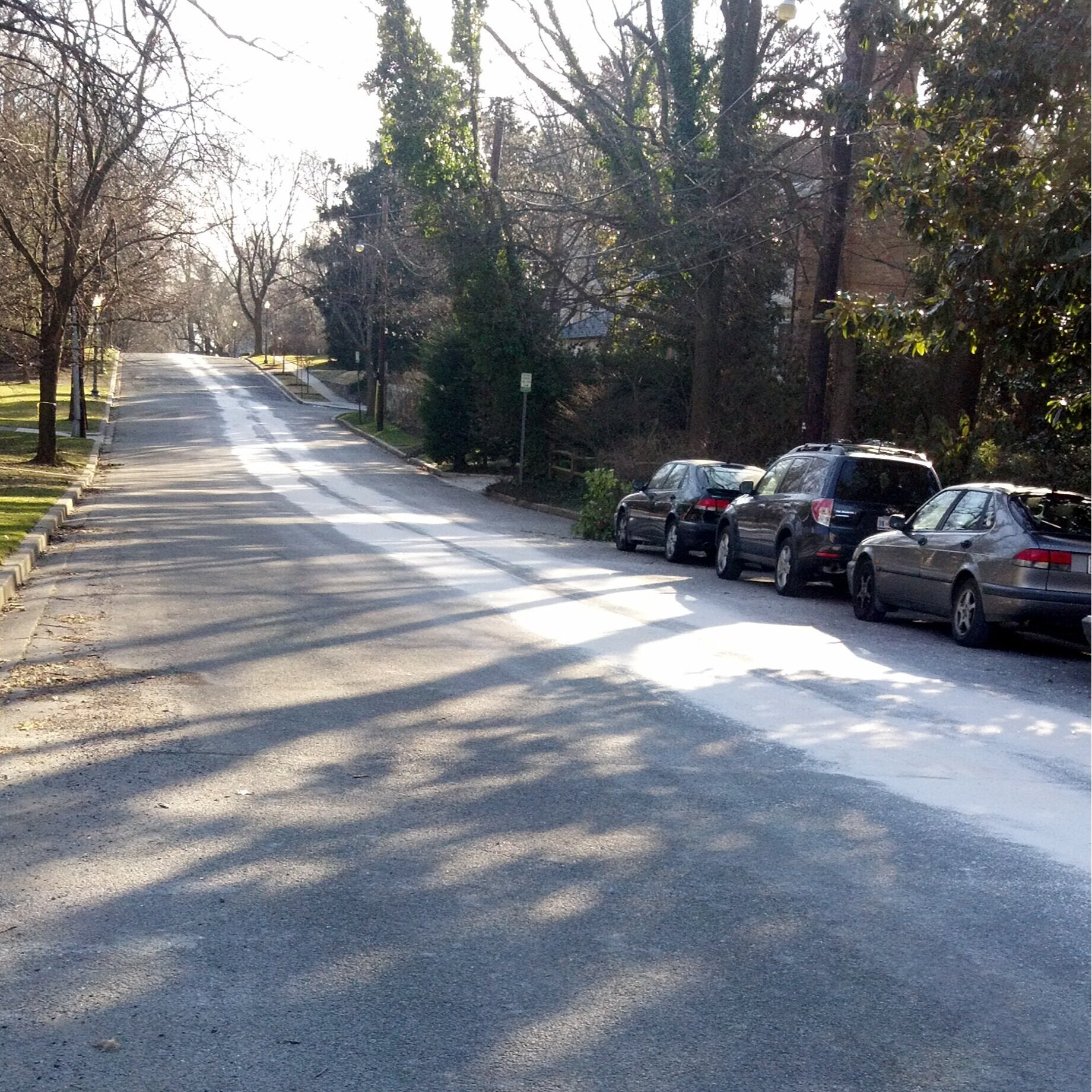
Too much on the road by Amerian University in Washington DC. The white stripes are salt that is four or five inches deep in some places.
All over the snowy regions, scientists are finding that road salt runoff poses an increasing threat to aquatic ecosystems. Although, the salt keeps the roads safer by lowering the melting temperature, there is an environmental cost. When it rains, the salt washes into creeks and rivers and raises the salinity of the water. Fish and other stream life cannot live in the salty water.
The Izaak Walton League has a program for citizen scientists to track the impact of road salts on local streams. We would love to have a tester in the watershed. Please contact Little Falls Watershed Alliance at stormwater@LFWA.org if you are interested.
The Izaak Walton League of America will send you free chloride test strips to take to your stream: one for a baseline reading, one for a reading after salt has been applied, and a couple more for readings after warm weather or storm runoff has washed the salt into the stream. You then upload your results through the Water Reporter app to a map. More information is HERE.
HERE'S an article from the Washington Post that does a good job of describing the issues.
For a lot of good information on what northern states are doing to minimize the effect of road salt, visit the New Hampshire Department of Environmental Services HERE.
And here's some information about how Minnesota DOT is cutting back on salt use.
Who is the Izaac Walton League?
From their website (http://www.iwla.org)
The Izaak Walton League was founded in 1922 to conserve outdoor America for future generations. The League's 54 founders, who were avid anglers, named the organization after Izaak Walton, the 17th century author of The Compleat Angler, a classic book about the art and spirit of fishing. We are one of the earliest conservation organizations to set an aggressive course to defend wild America by changing public policy. Almost every major, successful conservation program that America has in place today can be traced directly to a League activity or initiative.
There are over 240 chapters in local communities nationwide include three in the Montgomery County, MD area.
Salt from Roads is Contaminating Little Falls Creek
Not snow, but too much road salt.
Run-off from spills like this go directly to the creek and then to the Potomac River. A recent study shows that US rivers, including the Potomac, are becoming increasingly salter affecting the drinking water supply.
Urban streams like Little Falls Branch have it tough in the winter. As usual, the culprit is us. Because it's safer to have clear streets free of ice and snow, the people that plow the snow also put down salt – in huge quantities. As soon as things melt, much of that salt ends up in in the creek.
To document the impact of road salt run-off, LFWA volunteers are taking water samples to see how high salt levels are in the creek and how they are affected by snow storms. Stream team leader Frank Sanford is heading it up, working with the Izaak Walton League’s Winter Saltwatch. We are sampling at three locations: (1) in Somerset, just downstream of the bridge near the swimming pool, (2) in the Green Acres neighborhood, where the creek runs through a concrete channel and (3) below Massachusetts Avenue.
In general, levels during the summer and fall were safe enough for living things in the creek at both locations. However, after the snowfall on January 12 and 13 there was a dramatic increase. At the Somerset location, the concentration shot up from below 29 ppm in December to 299 ppm on January 15 and 548 ppm on the 18th. At the Massachusetts Ave. location, the concentration was literally off the chart – probably 800 ppm or more. That level is considered toxic for animal life; chronic exposures are unhealthy at as low as 230 ppm.
LFWA is working to make the municipalities who arrange for snow removal more aware of the problem, but with little effect so far. We hope that with continued sampling to demonstrate the very real impact of road salting, we may be able to make more progress.
Home owners can help reduce the impact of salt:
By limiting how much salt they use on their sidewalks and driveways. More is not better when it comes to salting.
By switching to magnesium chloride road salt. It continues to melt snow and ice until the temperature reaches -13 F. The salt releases 40% less chloride into the environment that either rock salt or calcium chloride.
By using a salt alternative – like kitty litter, sand or even a towel to cover slippery spots.
By reporting salt spills to 311. The County or DC Government will send someone out to clean them up. If they don’t, let your elected officials know.

Figure from From Izaak Walton League, Winter Salt Watch
Email the Planning Board Now
A New Life for the Willett Branch; A New Park for the Westbard Sector
New development is coming to the Westbard sector and it will increase the density of the area three-fold. New residential and mixed use building will be where small shops once operated. With this change, we MUST have green space. The Draft Master Plan proposes a new Stream Valley Park and a naturalized Willett Branch creek which would run through the sector like "a green ribbon" providing residents with walking trails, seating and a way to enjoy the outdoors.
Email the Planning Board HERE to tell them that you support this vision for the sector and that no changes should be made or exceptions granted in the new master plan. If the email doesn't work for you, you can download a sample letter HERE.
Email NOW! The Planning Board meets on December 3 to discuss the environment elements of the Proposed plan. More information about the Westbard Sector Plan rewrite is HERE.
WE WANT THIS,
Willett Branch as it could be.
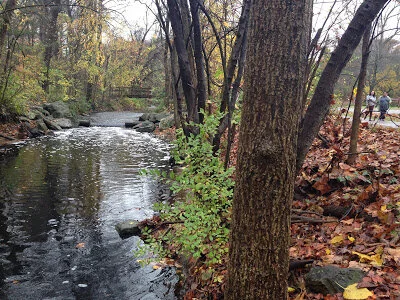
NOT THIS,

Sample Letter Supporting the Naturalization of the Willett Branch in the Westbard Sector.
Download a copy HERE.
Dear______________________
I support a Westbard Sector Plan that includes a naturalized Willett Branch. The environmental planners have come up with an innovated design that makes the creek an amenity for the area – a place where people can walk, enjoy nature and congregate. The current state of this creek is shameful. The walls are covered in graffiti and the banks are lined with trash. It winds behind the building where it is out of sight and out of mind. But it doesn’t have to be that way. Instead of turning their backs to the creek, new development would embrace the creek as part of their open space making the Westbard Sector a show place for the County.
Moving forward, we need open space for the new residents of the Westbard sector to stretch their legs and enjoy the beautiful natural area that the Little Falls watershed has to offer. Please vote to support a Master Plan with strong environmental component and a naturalized Willett Branch with no exemptions or waiver for any development or developer.
Sincerely,
______________________________
Contact Information
Planning Board
Casey Anderson, Chair
M-NCPPC
8787 Georgia Ave.
Silver Spring, MD 20910
MCP-Chair@mncppc-mc.org
County Council
Council Office Building
100 Maryland Avenue, 5th Floor
Rockville, MD 20850
county.council@montgomerycountymd.gov
County Executive Ike Leggett
Office of County Executive
Executive Office Building, 2nd floor
101 Monroe St., Rockville, MD 20850
ike.leggett@montgomerycountymd.gov
ocemail@montgomerycountymd.gov
EMAIL NOW: Support Needed for Willett Branch Park
Dear Neighbors,
As you know, the Westbard Sector Plan has a beautiful amenity that is central to the Plan - the Willett Branch Greenway. This is a beautiful new park planned to naturalize the Willett Branch and create a linear park that will wind through the sector along side the new Equity One development. It's the only meaningful green space in the plan.
The Park is jeopardized by Equity One's plan in partnership with the Housing Opportunity Commission (HOC) to build a parking garage creek-side behind the Westwood Tower Building which is owned by the HOC. We need public support of the park to convince the Planning staff to reject the plan. We are asking people to please take a minute from your busy holiday season to send an email to HOC and county planners opposing proposed building in the stream buffer, the flood plain or on top of the cemetery and asking for their support for the vision for the Willett Branch Stream Valley Park.
Send an email directly from our website
You can visit the Little Falls Watershed Alliance website for more information and to send an email directly. Click HERE.
Cut and Paste the Email Below
Below my signature, we have a longer email. You can copy it, personalize and send to planning@springfield20816.com This email address delivers your message to the HOC leadership, the County planners and the County Council.
These letters need to go out ASAP.
The HOC leadership and County officials may make a decision to build this garage as early as the end of the week when the Planning staff begins to draft their recommendations for the development for presentation to the Planning Board. They need to hear that you and the entire community strongly opposes any new buildings in the 100 foot stream buffer and flood plain of the creek and strongly supports the creation of Willett Branch SV Park as envisioned in the Sector Plan and promised by all sides during the lengthy public review process.
Learn About the Cemetery
Learn more about the cemetery that is along side the Westwood Tower HERE
Thank you,
Sarah
Sarah Morse
Executive Director
Little Falls Watershed Alliance
******************************************************************
Send to planning@springfield20816.com
Re: No HOC Garage in Stream Buffer of Willett Branch SV Park
Dear Commissioner Roman and County Planners,
Please don’t build any new buildings in stream buffer or flood plain or on top of the cemetery behind your Westwood Tower Apartments property which abuts the planned Willett Branch SV Park.
Montgomery Parks has a beautiful park planned for the Willett Branch in the Westbard Sector. The residents of HOC’s Westwood Tower Apartments will be big winners with this park, enjoying the benefits of nature, a sparkling creek, pedestrian trails that connect to the Capital Crescent Trail and lush green woods that will serve as their backyard and playground for their children.
Please join the community in supporting this new park. Specifically, I ask that HOC and its development partner, Equity One (merging with Regency Centers) not build a parking garage or any new structures behind the apartment building which is stream buffer for the Willett Branch. The garage would sit on the site of a cemetery which is the final resting place of many of the area’s post emancipation African American residents and would be in violation of MD environmental guidelines that require a 100-foot stream buffer.
Your support will ensure the creation of this park which will be a gem for the County and treasured by residents of Westbard most especially residents of your soon to be three building Westwood Tower Apartments complex. Your support will help make the Park a reality.
As a resident, I ask HOC to please not build any new buildings in stream buffer or flood plain or on top of the cemetery behind your Westwood Tower Apartments property which abuts the planned Willett Branch SV Park.
Thank you for your leadership in doing the right thing,
Sincerely,
[INSERT YOUR NAME HERE]
[INSERT YOUR NEIGHBORHOOD OR ADDRESS HERE]
MoCo Increases Rebates for Landscaping Projects
Great news for the watershed! Montgomery County just announced that the homeowner Rainscape rebates for landscaping that manages stormwater will increase to $7,500 per residence. Rainscape projects include rain gardens to capture the water and let it soak into the ground, conservation landscaping which uses native plants to create more nature environment that prevents rain water run-off; pervious pavement - which soaks the water up instead of allowing it to run-off and more!
If you want to see an example in the Little Falls watershed of how beautiful rain gardens and conservation landscaping can be, check out our project in Overlook behind their pool off btween 4405 and 4407Tournay Road, Bethesda MD.
*********************************************************
https://www2.montgomerycountymd.gov/mcgportalapps/Press_Detail.aspx?Item_ID=22574
Rebates for Montgomery County RainScapes Stormwater Projects Have Increased Dramatically
RainScapes is one of the signature water quality programs of the Department of Environmental Protection (DEP). It offers technical and financial assistance to encourage property owners to install environmentally friendly landscaping solutions that beautify properties and reduce runoff to local streams. RainScapes projects include rain gardens, conservation landscapes, green roofs, permeable pavers, rain barrels and cisterns.
For all pending and future RainScapes projects, the maximum per property Rewards Rebate has been increased to $7,500 per residential property, and $20,000 for properties owned by commercial entities, institutions, homeowner associations or nonprofit organizations. The new rebate maximums are three times greater than the previous residential rebate and twice as large as the previous institutional maximum. The new rebate schedule went into effect on October 1 and will include pending projects.
Since the launch of the RainScapes Rewards Rebate Program 11 years ago, 987 rebates have been distributed totaling $511,481.63. Properties owners who had installed RainScapes and received the maximum rebate under the old threshold, will now be able to add more projects.
“The increased rebates will allow more property owners to take advantage of the benefits of RainScapes and help their communities,” said Patty Bubar, interim director of the Department of Environmental Protection. “They will be able to build larger gardens and install innovative projects that will ensure that Montgomery County is a leader is community-driven stormwater management.”
RainScapes projects require pre-approval from DEP in order to receive a rebate, except for rain barrel installation projects. Approved projects are expected to be completed within six months. Rebates are awarded based on a final inspection of the project and submittal of receipts.
RainScapes rebates are funded through the Montgomery County Water Quality Protection Charge. Once a RainScapes project is installed, residents can apply for a reduction to their property tax bill in the form of a credit for maintaining their project.
Watershed Groups Making an Economic Difference
Watershed groups have a positive impact on local water quality, study finds
October 12, 2018 by Chris Branam, Oregon State University
Economists have found that in the United States, watershed groups have had a positive impact on their local water quality.
The study is published in the journal Proceedings of the National Academy of Sciences. This is the first empirical evidence that nonprofit organizations can provide public goods, said Christian Langpap, an Oregon State University economist and study co-author with Laura Grant, an assistant professor of economics at Claremont McKenna College.
In economics, a public good is a commodity or service that individuals cannot be effectively excluded from using, and where use by one individual does not reduce availability to others. For these reasons, public goods can't be provided for profit and nonprofits can play an important role.
"Environmental nonprofit groups are assumed to provide public goods," said Langpap, an associate professor in OSU's College of Agricultural Sciences. "But until now that assumption has never been tested empirically. We determined that the presence of water groups in a watershed resulted in improved water quality and higher proportions of swimmable and fishable water bodies."
The presence and activity of watershed groups can impact water quality in various ways, including oversight and monitoring, direct actions such as organizing volunteers for cleanups or restoration, and indirect actions like advocacy and education.
The researchers' analysis combined data on water quality and watershed groups for 2,150 watersheds in the continental United States from 1996 to 2008. The number of watershed groups across the lower 48 tripled during this period, from 500 to 1,500.
Grant and Langpap constructed a model that considered dissolved oxygen deficiency as the measurement of water quality. Dissolved oxygen deficiency is the most common and overarching measure of water quality because dissolved oxygen is critical for many forms of aquatic life that use oxygen in respiration, including fish, invertebrates, bacteria and plants. It was also the water quality measure that had the most data available during the study period.
The researchers used three measures of group activity in a watershed in a given year: total number of active groups, total donations to all groups in the watershed and total expenditures by groups in the watershed.
The model produced some significant results. For example, a nonprofit in a watershed was associated with reduced dissolved oxygen deficiency relative to a watershed in which there were no groups.
Additionally, a $100,000 increase in total donations to nonprofits in a watershed, equivalent to a 10 percent increase to the average, also was associated with reduced dissolved oxygen deficiency. And a $100,000 increase in nonprofit expenditures, a 7 percent increase, was also associated with improved water quality.
They controlled for additional factors that impact water quality at the watershed level: violations of the U.S. Clean Water Act, spending via federal water quality programs, land use, precipitation, election outcomes, population density, per capita income, educational attainment, ethnicity, home ownership and unemployment.
"This is a unique data set that allowed this question to be answered empirically," Langpap said. "We painstakingly gathered this list of watershed groups. Once we had their location, we could match them to their watershed. Using their tax records, we knew how much they received in donations and how much they spent."
Study is at: http://www.pnas.org/content/early/2018/10/02/1805336115