
Thank you to all our supporter in yesterday's DoMore24.org fundraising frenzy. We won prizes for the most donors and for the most donations in the Environment and Community Category. That's an extra $5,000 on top of the $3,937 raised.
It just reconfirms the importance of small local groups. We are the only watershed group working directly for the Little Falls creek and our work matters. We pick up trash, we free trees from vines, we restore meadows and other native habitats and we watch out for the creek.
The parks and the creeks are treasures in our densely populated and we are proud to speak for them. Thanks for helping us help the environment.
Have you seen this plant - Leatherleaf Mahonia?

Last week, I led a weed removal work day for folks from the Marriott Corporation. We worked off of Little Falls Parkway and got a lot done. (See our
for pictures). I was working with Frank Sanford, another weed warrior supervisor, and we came across a plant neither of us knew - pretty holly like plant with really flat compound leaves. Yesterday, with the help of another weed warrior, I IDed it. It's Leatherleaf Mahonia and wouldn't you know it - there's an invasive alert out for it from the National Park Service. It's been identified as a potential threat in Montgomery County and other parts of Maryland.
This just points to why we need to keep focusing on natives. We never know when a perfectly good landscaping plant will go rogue. This was the case for non-native bush honeysuckle. It was a great landscaping plant for some 80 years until the climate changed, or something changed and it escaped into the forest where it has taken over.
Hopefully we can nip a full scale invasion of Leatherleaf Mahonia in the bud (so to speak). So much work to do!
A Meadow for Norwood Park!
The vines are gone, the bush honeysuckle has been cut back and a meadow is coming to Norwood Park. Little Falls Watershed Alliance is partnering with Montgomery Parks to restore a meadow below the soccer fields at the west end of the park.
Dozens of volunteers have spent 100s of hours cleaning out bush honeysuckle, porcelainberry vines, multi-flora rose and other invasive non-native plants. All their hard work has paid off as the debris will be removed, the land tilled and replanted with native flowers and shrubs.
Work will begin in late May or early June to clear the piles of logs and other debris. Community planting days are planned for the fall and spring of 2015.
Thank you to Whole Foods whose generous donation made this possible.
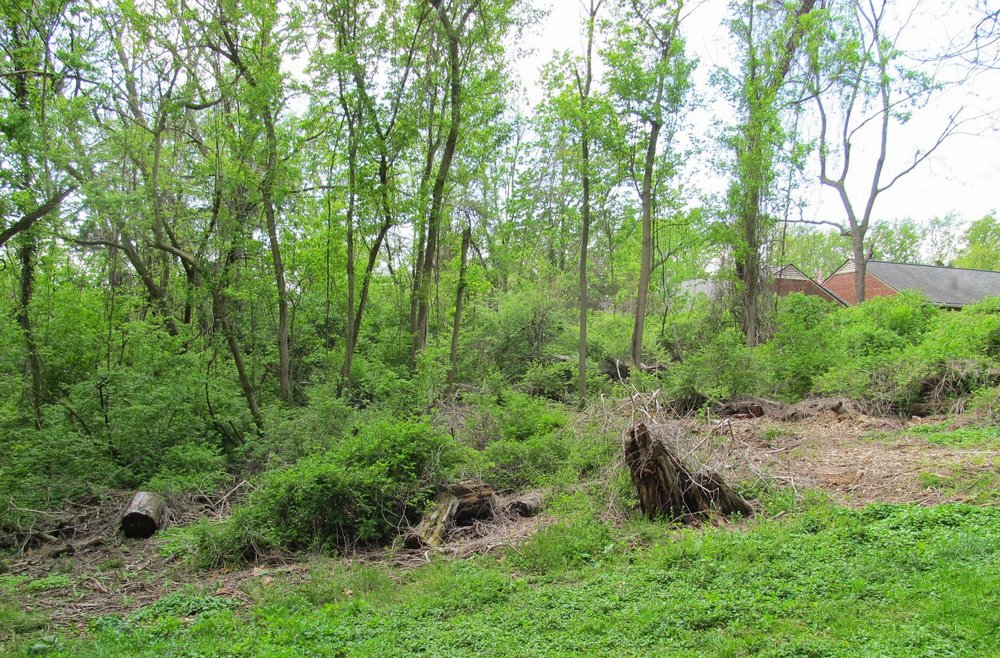
A Meadow for Norwood Park: Imagine all this debris removed and wildflowers blooming in their spot. Work will start in late May and June with community planting days planned for the fall of 2014 and Spring 2015.
Trash is Gone, the Watershed is Clean!
April 12 was our annual watershed clean-up and it was a beautiful day for getting in the creek and getting the trash out!
The officials numbers are:
37 bags of trash
8 bags of recycling
one shopping cart
one bike
one suitcase
miscellaneous metal pieces and car part
64 volunteers for a total of 161 hours
woo! woo!
We also pulled garlic mustard that day. This invasive weed was just starting to show its head, but we managed to pull 8 bags.
Thank you to everyone who came out and to the Westmoreland Garden Club who partners with us every year taking the lower part of the Little Falls Branch while we take the upper part and the Willett Branch. And thanks to Tim Eden and his son for volunteering the next weekend to finish the job by picking up the creek that runs between Kenwood and the Little Falls Parkway.
Planting for Butterflies
I have been revisiting Doug Tallamy's excellent book Bringing Nature Home when I came across this list of natives to plant to attract butterflies and moths on his website. Doug's book is an exhaustive and inspiring look at natives plants and their place in the food chain. Even if you can only plant two of three of these flowers in your yard, you are creating a habitat that will pay off not only in butterflies and moths, but in song birds and more. Non-natives have no food value for many of our pollinators which then effects the birds that eat the larva of these insects and so on up the food chain.
So, when you're thinking of what to plant this year - take this list with you and see if you can't find some room for some of these lovely flowers in your yard.
Common Name Plant Genus Number of Butterfly/moth species supported
Goldenrod Solidago 115
Asters Aster 112
Sunflower Helianthus 73
Joe pye, Boneset Eupatorium 42
Morning glory Ipomoea 39
Sedges Carex 36
Honeysuckle Lonicera 36
Lupine Lupinus 33
Violets Viola 29
Geraniums Geranium 23
Black-eyed susan Rudbeckia 17
Iris Iris 17
Evening primrose Oenothera 16
Milkweed Asclepias 12
Verbena Verbena 11
Beardtongue Penstemon 8
Phlox Phlox 8
Bee balm Monarda 7
Veronica Veronica 6
Little bluestem Schizachyrium 6
Cardinal flower Lobelia 4
Planting for the Environment
The snow is gone...let's plant! Here are some local and desirable groundcover, shrub and trees to consider:
Shady Perrenials: Aster divaricatus, Eastern purple coneflower, joe pye weed, cardinal flower and monarda spp for butterflies, Sedum "autumn joy", Ginger, moss phlox, Christmas fern and bluebells for shady groundcover;
Sunny Perrenials: green and gold, golden coneflower and creeping phlox (get the rabbit proof version), foam flower, and sedum 'autumn joy' for sun.
Vines - Trumpet honeysuckle for climbing floral.
Shrubs - Witchhazel, spice bush, blueberry and cherry bush.
Trees - Paw Paw, red bud, arborvitae (evergreen).
These plants are beautiful, and local to the area, so they are more durable than non-native plants. They are diverse in texture and character, and low maintenance. The added benefit of these plants is that they don't attract rodents and rabbits for housing (like ivy and liriope), they don't change the soil constitution (like bush honeysuckle), and by buying local, you are contributing to our native habitat: if birds deliver the seeds from your plants to our local parks, it fosters native growth. For a wallet sized guide of recommended landscape plants, contact us at info@LFWA.org and we'll put one in the mail to you or click HERE and we have lists online.
Other Plant News:
Dinner and a Show (of sorts)
Montgomery Parks Weed Warrior Training
April 28, 5:30 to 7:30
Norwood Park, Chevy Chase, MD
Click HERE for complete information and registration instructions.
Have you ever wished you could tell the native plants and trees from the invasive ones in the Park? Join us, and get to know the difference! Dinner will be served. If you attend only one certification training this year, let it be this one.
45 New Trees and Shrubs!
What graces the Massachusetts Avenue entrance to Little Falls Park as of 3/15, thanks to the State Highway Administration (SHA). SHA removed bamboo, bush honeysuckle, privet and vines that were making their way into the Park, and installed fir, holly, red bud, service berry, and viburnum. Thank you, SHA, for being Park Stewards.
Little Falls Park Restoration
The Park's third deer exclosure is one month old, installed by volunteers. The plan is to restore all three exclosure areas to native habitat. Many remember when the Park was full of Virginia Bluebells, song birds and butterflies. If you want to help Park restoration efforts:
plant native plants in your yard that birds, bees and butterflies love, and remove plants that invade the Park (most via birds) and crowd out natives, such as ivy, winter creeper, bush honeysuckle, bamboo, privet, multiflora rose, mile a minute, and wineberry;
reduce the noise of lawn care in order to create a desirable habitat for native mammals, reptiles, amphibians, birds, butterflies;
trap rainwater in your yard (and get paid by the County to do it) to allow native aquatic life to survive in Little Falls Valley Stream;
contact lfwa.org, "events" tab to participate in weed pulls, or contact lfwa.org to lead Park tours, give native plant talks, lead weed pulls, remove trash from Little Falls Stream;
subscribe to the monthly e-letter at lfwa.org, the Park and stormwater management stewards of Little Falls Park, in order to stay informed. lfwa.org has information on everything mentioned above.
Park history documentation –
Do you have photos of what the park looked like 25 or more years ago? Make copies and send them to us, or better yet, scan them and send a digital copy.
Spice bush is getting ready to bloom, so come enjoy the Park's beauty!
Little Falls Watershed Alliance (lfwa.org)
What to Do About English Ivy?
The Invasive of the Month for March is English Ivy, the ubiquitous landscaping plant that is taking over the forest. Everyone loves English Ivy in their yards because it's fast growing, crowds out weeds and adds green all year round. Unforturnately these are the reasons that make it one of the most unloved plants in the Park and one of the most destructive invasives! It forms a dense cover on the forest floor crowding out native plants including all our spring wildflowers. Because it stays green all year, the perennial natives have no room to emerge in the spring. If it is allowed to climb trees, it can damage the bark and the sheer weight of the ivy can break branches and topple trees in a storm.
Replace Your English Ivy with Native Ground Covers!
If allowed to grow in your garden, it can easily escape to nearby forest wreaking havoc to the local ecology. You can help the park by using native ground covers. You should always remove it from your trees both for your safety and the trees health.
Replace your ivy with some of the following native ground covers:
A combination of Heuchera villosa 'Autumn Bride' and Christmas fern (Polystichum aristichoides) are nice in shade, and will tolerate some dryness.
Pennsylvania sedge (Carex pennsylvanica) or wild columbine are beautiful.
Other covers include Virginia creeper (Parthenocissus quinquefolia), wild ginger (Asarum canadense) and foam flower (Tiarella cordifolia).
Local nurseries such as American Plant or Meadows Farms may carry these plants. You just have to be very specific with them about the Latin names, so you know exactly what you are getting. The native plant sales are also good places to look for ground covers. Visit the Maryland Native Plant Society for a list of sales.
The National Park Service has an excellent list of natives that can be used as ground covers as well as a list of plants (like bush honey suckle) that should never be used in your gardens as they are so invasive and harmful to the environment.
Cages in the Park - What's that All About?
Enclosures in Little Falls Park?
You may have noticed big fences in areas when you are walking along the path in the Park below Massachusetts and Little Falls and wondered what is being caged in.
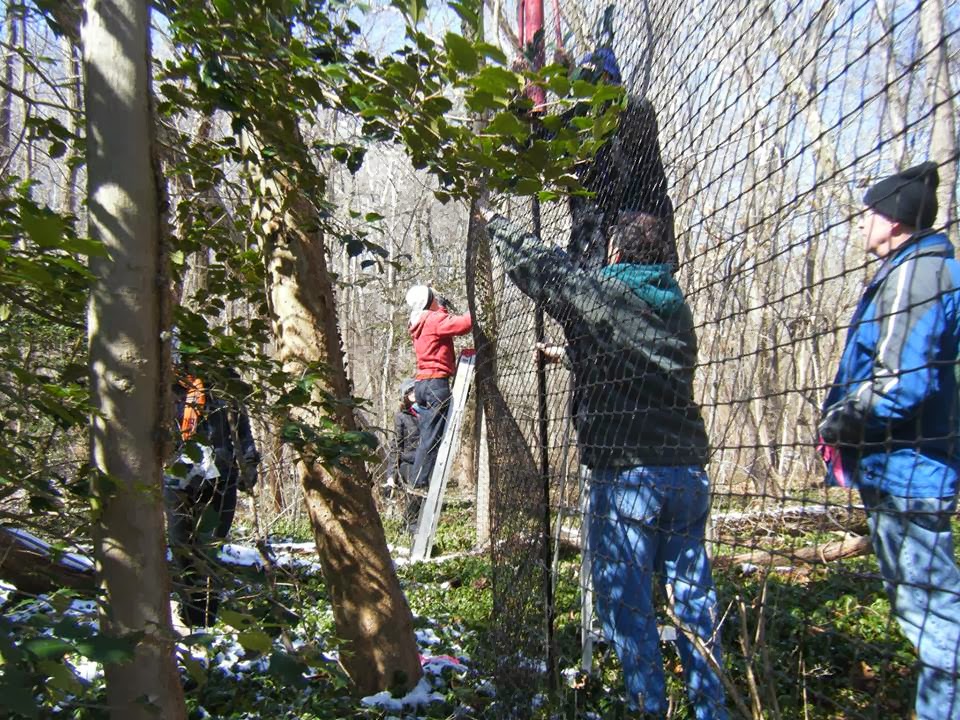
Volunteers installing a deer exclosure, one of three in the Park.
These are actually "deer exclosures" and they are areas protected from deer by netting wrapped around posts.
The areas are being actively returned to native habitat, which is a multi-step process:
Rid the area of invasives;
Let area rest free of invasive to allow the soil to mend (its nutrients are leeched by invasives);
Add native plants suited areas as available;
Allow the area to seed naturally;
Give the plants the freedom to expand.
There are 3 exclosures (and some other areas of note near them):
The exclosure near the park entrance at Little Falls Parkway and Massachusetts Avenue, on the right, is shady, and protects one of the last areas of Virginia bluebells and wild ginger in the Park;
The exclosure on the left further from Massachusetts Ave. is in a sunny location, and is the recipient of viburnum and hazelnut shrubs.
Further along that side, not enclosed, is swamp milkweed, which is a larval host to the Monarch butterfly and a great nectar plant, and will bloom with a pink flower;
The third exclosure is at the Albemarle entrance to the Park, and while it has many invasives which must be removed, it also has a beautiful grove of holly, and several paw paw and spicebushes, which provide food for songbirds and the Spicebush Swallowtail butterflies and Spicebush Swallowtail Caterpillar. All of these plants are available at Garden stores if you wish to replicate this look in your yard.
Help us Maintain the Exclosures
The exclosures were erected by Montgomery Parks as part of a joint venture between Parks, LFWA, and neighbors of Westmoreland Citizens Association.
If you would like to help with this effort, consider adopting an exclosure under the guidance of a Weed Warrior Supervisor and help us choose names for the exclosures.
If you see vines on the mesh, gently remove the vines.
If you see rips, which would allow deer to enter and strip the seedlings and eat plants, please contact LFWA at info@LFWA.org.
What's the Purpose of the Caged Trees at Little Falls Park?
These cages were established by the same joint venture.
The seedlings are caged to protect them from being stripped by deer.
They include:
Native viburnum, which is a larval food plant for the spring azure butterfly and several moths. Its fruit is eaten by the phoebe, mockingbird, robin, brown thrasher, northern flicker, cardinal, cedar waxwing, vireo, bluebird, and grosbeak. The plant is also used by several bird species for cover and nesting;
Oaks, whose acorns provide food for more than 100 U.S. vertebrate species;
Spicebush , which provide food for songbirds and Spicebush Swallowtail butterflies;
Sycamores, which grow to 60-100 feet tall, have seeds inside the "button balls" which are eaten by American and Purple Goldfinches, Carolina Chickadees, Mallards, Beavers, Muskrats and Squirrels.
If you wish to nurture the growth of these plants and trees, you can help by removing any vines which might climb the cage.
You can gently lift limbs back inside which poke out of the cage.
Please do not push or pull the posts which ground the cage, and if you see that one has snapped, please contact
contact LFWA at info@LFWA.org.
Join your neighbors who have generously donated to make these exclosures and plants possible. You can earmark your donation for Little Falls Park and send it to LFWA.org. All donations are tax deductible.
The restoration of a Park is a long term process, and there are many ways to be involved in it.
Contact www.LFWA.org to get more involved.
Westwood Complex in the News
Reposted from the Bethesda Patch
Developer Talking with Neighbors About How to Improve Westwood Centers
The Giant grocery is one of the anchors of a complex that may be redeveloped by Equity One in Bethesda.
Posted by
(Editor) ,
February 19, 2014 at 05:33 PM

The Giant grocery is one of the anchors of a complex that may be redeveloped by Equity One in Bethesda. Credit: WestBard Vision website.
Equity One Inc. has paid $65 million to buy the Westwood Shopping Center and neighboring Westwood Center II in Bethesda, reports
.
That gives the company parcels totaling 467,000 square feet of retail, office and multifamily space it needed as part of its plan to develop a mixed-use community on the southeast edge of downtown Bethesda, the website says.
Last year Equity One spent $140 million to purchase the Westwood Towers, Springhouse by Manor Care, Bowlmor Lanes and two Citgo gas stations. Equity now has control of a 22-acre mixed-use area that includes a 55-year-old Giant grocery, an apartment building and a 62-unit assisted living facility.
The properties are located between Westbard Avenue and River Road.
The company has created a website for the project that says it will re-develop the shopping center and businesses over several years, taking neighbors' views into account.
Equity held two recent community meetings to assess neighbors’ views on redevelopment. Information about upcoming meetings and other plans can be found at westbardvision.com
Workshops for Improving Your Yard and the Environment
The RainScapes program has workshops for Property Owners interested in learning about how to reduce runoff and solve their site issues in a way that reduces stormwater runoff.
RainScapes Workshops for Property Owners
Workshop Dates and Times:
Thursday, April 3, 2014, 4 – 7pm (Course #272199) OR
Friday, April 4, 2014 10 am – 1 pm (Course #272249)
Where: Brookside Gardens Visitors Center Adult Classroom
Fee: $12 for Friends of Brookside Gardens or $15 for non-members
Registration required at www.parkpass.org (Registration opens February 15th)
Workshop: Planning on doing some spring landscaping? Before you do, make sure to attend this workshop so you can learn how to turn a simple landscape into an environmentally friendly RainScape!
This workshop will focus on our most effective RainScape: rain gardens! Rain gardens are saucer shaped gardens designed to temporarily pond water after a rainstorm. Instead of polluted rainwater running off your land and into our streams, the rain garden gives that water a chance to soak into the ground. The soil in the rain garden filters and cleans the water.
At this workshop you will learn how to evaluate your yard and gain the knowledge needed to create a rain garden. You will also learn how to apply for a rebate for your rain garden from Montgomery County’s RainScapes Rewards rebate program. Each attendee will be provided with light refreshments as well as a few native plants they can take home to help start transforming their landscape into a RainScape!
RainScapes “Make and Take” Rain Barrel Workshop
NOTE LOCATION! This class is offered at Montgomery College in Germantown.
Workshop Dates and Times:
Friday, April 25, 2014, 10am – 1pm (Course #272299) OR
Saturday, April 26, 2014, 10am – 1pm (Course #272349)
Where: Montgomery College Germantown Campus, Greenhouse
Fee: $12 for Friends of Brookside Gardens or $15 for non-members
Registration required at www.parkpass.org (Registration opens February 15th)
About this Workshop: Do you want to lessen the amount of tap water you use to water your garden? Do you want to help the environment by slowing down stormwater? If the answer is yes to either of those questions then what you want is a rain barrel!
A rain barrel collects and temporarily stores rainwater from your rooftop downspout. Every gallon you capture is one less gallon going down the storm drain and you also end up with a free source of water for watering your garden.
At this workshop you will learn the importance of stormwater control and you will gain the knowledge necessary to install your own rain barrel. You will also learn how to apply for a rebate for future rain barrels from Montgomery County’s RainScapes Rewards rebate program. Each attendee will be provided with light refreshments as well as one rain barrel with parts (one per household) to take home with them. Remember to bring a vehicle large enough to carry a 55-gallon (2’ x 3’) barrel home!
RainScapes Conservation Landscape Workshop
Workshop Dates and Times:
Thursday, May 15, 2014, 4 – 7pm (Course #272350) OR
Friday, May 16, 2014, 10am – 1pm (Course #272351)
Where: Brookside Gardens, Visitors Center Adult Classroom
Fee: $12 for Friends of Brookside Gardens or $15 for non-members
Registration required at www.parkpass.org (Registration opens February 15th)
About this Workshop: This workshop will focus on conservation landscapes which are gardens planted with native plants. The native plants are deep rooted so they help slow down and soak up the rainwater. Instead of polluted rain water running off your land and into our streams, the conservation landscape gives that water a chance to soak into the ground.
Attendees will learn how to evaluate their yard and gain the knowledge needed to create a conservation landscape. They will also learn how to apply for a rebate for conservation landscaping from Montgomery County’s RainScapes Rewards rebate program. Light refreshments will be provided as well as a few native plants, for taking home to help start transforming their landscape into a RainScape!
Note: Registration for spring and summer classes begins February 15th. Register by calling 301-962-1451, using ParkPASS.org, or in person at the Brookside Gardens Visitors Center. When registering, note the course number.