
On Saturday, October 18, our stream team did the fall sampling for benthic macroinvertebrates in the Little Falls Creek. For the second time this year, planaria were the star of the show accounting for more than half of the organisms we found. Black fly larvae were also found in abundance - 26% of the total count.
Fecal Bacteria Levels Remain High in Watershed
For the fifth consecutive summer, the fecal bacteria levels in the Little Falls watershed have exceeded the Maryland State Standards for recreational water use - even for infrequent human contact. According to our 16-week study conducted at eight sites, the Little Falls Branch, the Willett Branch and the Minnehaha Branch fail to meet the criteria for safe water play at all locations.
News from Norwood Park
The latest issue of the Norwood Park Arboriculture Project newsletter is HERE - filled with compelling news and ideas. Please take a few moments to see what's new with the trees around the Park, and how you can help the ecology in your yards, pots and community spaces.
Read about the trees in the park, the non-native invasives in the park and the results of our bird counts.
Register for our fall bird walk (October 12), tree tour (October 12) and creatures of the night (October 3) HERE.
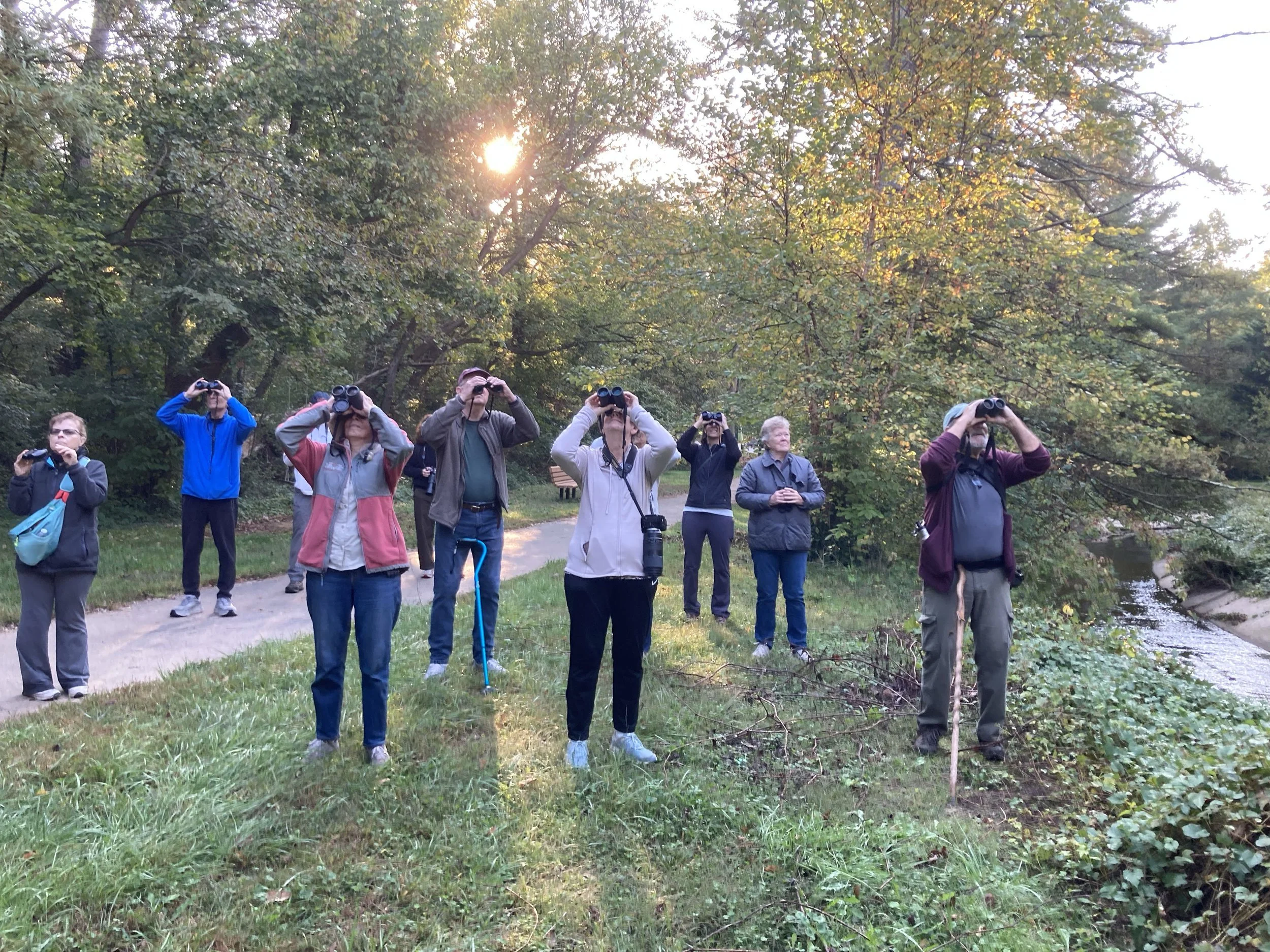
Birding in Norwood Park. Photo by Adele Medina O’Dowd
Summer Sampling Shows Creek Health as Poor to Fair
On Saturday, July 6, our stream team did the summer sampling for benthic macroinvertebrates in the Little Falls Creek. Planaria were the star of the show accounting for more than a third of the organisms we found. Small Minnow mayflies were also found in abundance. We found nine different species in all, giving the creek BIBI score of 2.1 which puts it in the very low Fair category.
Fecal Bacteria Testing Starts with a big FAIL
It’s the second week of our summer fecal bacteria testing program and all three creeks in the watershed have failed to meet the MD Standards for Safe Water Play. This is the second week in a row that the sites on the Willett Branch have failed; The Little Falls site below Mass Avenue failed again. And the Minnehaha creek site has shown serious fecal pollution for the past two weeks. This is the first year that we have tested the Minnehaha Branch.
Spring Bird Count, Norwood Park
Summer News from Norwood Park Aboriculture Project
Lighting Bugs, Summer Bird Count, iNaturalist workshop, DIY mosquito management, and more. Learn more about what is going on in Norwood Park and the Norwood Park Arboriculture Project HERE.
Salt Testing Shows Toxic Levels Continue into Spring

Snow plow painted by LFWA volunteers to raise public awareness of the threat road salt presents to aquatic life. Plow designed by Toby Kathan.
Volunteers testing creeks in the Little Falls watershed found that salt readings in area creeks spiked to toxic levels after snow storms, but they did not always return to safe levels after the events. April readings showed that chronic toxicity (over 230 parts per million) remains in 3 locations on the Little Falls Branch - by the Somerset Pool, by the Willard Avenue Neighborhood Park, and by Westbrook Elementary School. Chronic toxicity means that the habitat of the aquatic life that depends on fresh water is compromised to the point where they cannot survive.
Results from April 2025 Salt testing show chronic toxicity is still a problem at three locations along the Little Falls Branch despite the fact that the last snow event was over a month ago.
Since December 2024, trained LFWA volunteers have tested 8 sites along the Minnehaha, Little Falls and Willett Branch creeks before and after snow storms as well as once a month in the warmer months. The data shows that we have a serious salt pollution problem in the watershed. Most of our sites experienced spikes to levels of over 860 PPM after snow events. Chloride is naturally present in the environment. Chloride concentrations between 1 and 100 ppm (mg/L) are “normal” in most freshwater waterways. But levels over 230 PPM are considered chronic toxicity as aquatic organisms cannot tolerance this much salt for more than a few days. Levels over 860 are considered acute toxicity as the organisms can only survive for several hours at this level.
Read our report on the state of Salt in the watershed HERE.

Problems with Salt Pollution
High levels of salt also have inverse impact on human health, contamination our drinking water. And there are costs to infrastructure. Chloride can corrode metal, concrete, bridges, vehicles, drainage systems, highway fixtures and drinking water pipes. Izaak Walton league estimates that the long term costs associated with salt pollution effects on the infrastructure will cost between $16 - $66 billion a year, if we continue to use salt at the current rate.
There is also a concern about salt in the water comes from local waterways. WSSC, which treats drinking water for Montgomery County has seen an alarming rise in the salinity of the Potomac River - a 41% increase in the past 30 years. “WSSC Water closely monitors the water entering our Potomac and Patuxent Water Filtration Plants. Over the past 30 years, the average salt levels (sodium and chloride are the two components of salt) have been steadily increasing. The levels peak in the winter months and are higher in years where we experience more winter weather events. Because there is no economically feasible way to remove salt during filtration, higher levels end up in the drinking water.” https://www.wsscwater.com/saltwise
For an excellent review of the concerns about salt pollution, there is this article from the Izaak Walton Salt Watch program.
LFWA Salt testing program

Salt testing sites in the Little Falls watershed.
LFWA has been testing four streams in our watershed for salt pollution since 2021. We have one site on the Glenbrook tributary, one site on the Willett Branch, one site on the Minnehaha creek and 5 sites long the Little Falls Branch.
The most up-to-date readings can be found HERE along with information about our salt testing program.
thank you
Thank you to Woody Stanley and our salt volunteers for their hard work on documenting the problem of road salt in the watershed.
This program is run in partnership with Izaak Walton Salt Watch.
Ameletid minnow mayfly found in Spring monitoring
LFWA Celebrates 17 years of Stewardship with Gala Event

March 9 was our birthday and we celebrated with music, dinner, birthday cake and special recognition for super volunteers.
Maryland State Delegate Marc Korman joined us as our key note speaker and delivered a talk on recent environmental bills in Annapolis. Korman was also honored with a LFWA Bacteria Monitoring Team t-shirt in recognition of his role in helping to solve the fecal bacteria problem on the Willett Branch.

Five super volunteers were recognized for their many hours of service. These volunteers had the most hours of any volunteers who are not in a leadership position. Julie Steinberg is one of LFWA first volunteers, showing up in our data base in 2009. She has volunteered 99 hours. Colette Cowey is another long time member and volunteer joining LFWA in 2012 or maybe earilier. She has 156 hours hours. Averill Simone was the youngest volunteer to be recognized. She joined LFWA in 2022 and has already volunteered 82 hours at 42 events. Sally Winthrop joined LFWA in 2021 and has volunteered at 60 events for a total of 90 hours. Emily Cordas also has 90 hours participating in 77 events since joining LFWA in 2020.

Super Volunteers 2025 with LFWA Director Sarah Morse: from left: Sally Winthrop, Emily Cordas, Averill Simone, Sarah Morse, Julie Steinberg, Colette Cowey.


LFWA board members, from left: Emily Simone, Sara Robinson, Karen Thornton, Jack Sobel, George Wyeth and Mikel Moore. Not pictured is John Drake.
The evening ended with the election of a new board. We are happy to have Karen Thornton back as President, John Drake is Vice President, George Wyeth continues as Treasurer and Sara Robinson is our long time Secretary. Emily Simone, Jack Sobel, and Mikel Moore comprise the rest of the board. Board member Josie Gabel has retired. We are grateful for her service and leadership.
thank yous
Thank you to Pete Papageorge for the fabulous music and to Westmoreland Church for use of their beautiful space. To Julie and Karen for helping serve the food. To Keith for the delicious bread, to Sarah Morse for the delicious birthday cake and desserts, to everyone who put away tables and chairs at the end, and, of course, to all the volunteers who make LFWA possible. We cannot do it without you.